I am Dr Romina Istratii, a scholar, researcher, international development practitioner, educational film writer and social entrepreneur with fifteen years’ experience responding to gender-related inequalities, domestic violence and conflict-related sexual violence in faith communities affected by humanitarian emergencies, development challenges and migration.
Raised in a low-income migrant family and having witnessed domestic abuse in early life, I found refuge in painting. Art became a way of preserving my mental health, finding moments of peace and expressing what could not always be put into words. Although I undertook some occasional training during my student life and later completed numerous art courses during my university years in the US, I eventually set art aside to pursue my academic ambitions. My research took me into the field, primarily across West and East Africa, where I sought to understand and address complex social challenges. Yet, somewhere along the way, I felt that I had lost a part of myself.
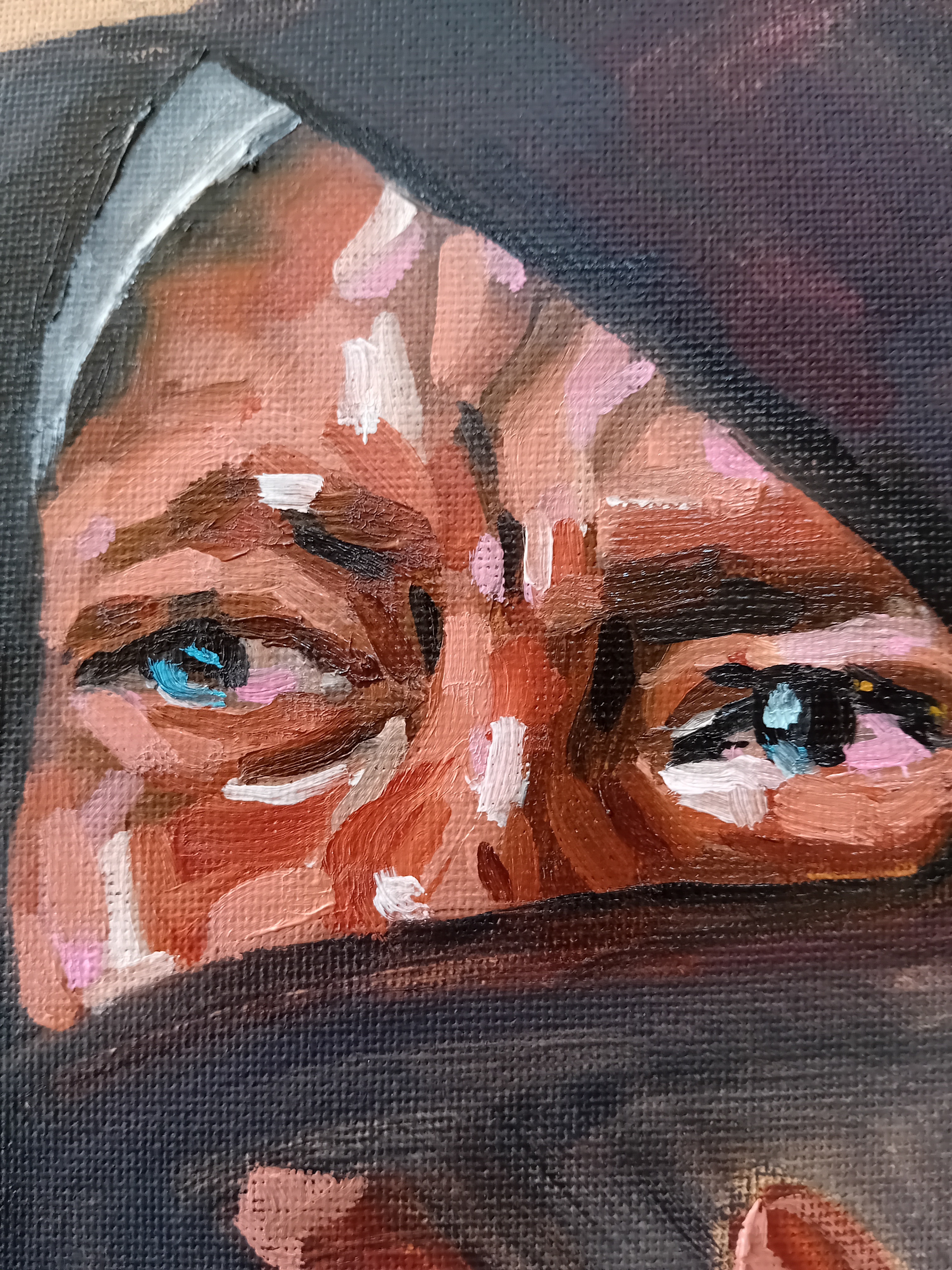
That part began to return following the outbreak of conflict in Tigray, Ethiopia, in November 2020. Based in Addis Ababa, I witnessed the devastating consequences of the war and encountered extensive reports of sexual violence against women. Faced with the scale of suffering, I returned to art—not simply as a personal refuge, but as another way of bearing witness and building awareness in the public about the scale of the issue.
I began creating a series of portraits inspired by journalistic photographs of Tigrayan and other Ethiopian women affected by war and sexual violence. Through these works, I sought to bring attention to women’s experiences, resist the erasure of their suffering and create space for reflection on the human realities behind the headlines.
In 2025, while pursuing studies in entrepreneurship at the University of Cambridge, I showcased this campaign at the student-led Hughes Hall Arts Festival. The artwork also became a means of fundraising for a project seeking to develop a spiritual framework responsive to the needs of Ethiopian Orthodox Tewahedo women affected by conflict and sexual violence in Tigray and beyond.
After this project, I left my academic position and transitioned to social enterpreneuship, establishing and leading the Institute of Domestic Violence, Religion & Migration. Following personal health challenges over the past year, I have once again turned to painting to find peace and to cope. This time, I am approaching it with a renewed sense of purpose: as a way of reconnecting with myself, but also of using creative means, rather than solely scholarly tools, to raise awareness of the issues I have spent my career working to address.
For me, returning to art has meant reconnecting parts of myself that had long been separated: the person who once turned to creativity to find peace, the researcher seeking to understand and respond to violence in its different social contexts and the practitioner working alongside others to develop more responsive ways of addressing it.
Art as a Space for Reflection and Change
The current portfolio features two series that explore different human experiences, but they share a common purpose: to bring attention to realities and people who deserve to be seen.
The collection *Women and Conflict: Faces of Suffering and Resilience* bears witness to women whose lives have been affected by violence in the Tigray conflict, their on-going suffering but also their active forbearance in the face of trauma and adversity.
The collection *Ordinary Men: Celebrating the Quiet Ones* counters sensationalist voices and harmful ideas about masculinity in the so-called ‘manosphere’ by shining a light on men I have personally known who try to embody care, integrity and compassion in their everyday lives, without seeking applause or recognition.
By juxtaposing these collections, my aim is to resist tendencies to divide perpetrators and victims along gender lines. Together, these series reflect my belief that addressing violence requires us not only to confront harm, but also to reward and encourage behaviours that counter harm and quietly protect the most vulnerable, including women and children, from domestic and sexual violence.
Through art, I seek to raise awareness, invite reflection and celebrate the humanity we must never lose sight of. The content is personal and does not reflect institutional views, aims or motivations. This is an individual project and a journey that anyone curious is invited to join.

